Overview
In any Core Banking System, for every financial transaction, accounting entries are generated. In general, accounting entries are classified into customer entries (the entries that impact the customer account balance), Bank’s P&L entries (the entries that impact the Bank’s P&L), and Contingent Entries (the entries generated as a result of special events like accrual). As a result, the account entries impact the customer account balances. In the Infinity UI, the customer-related entries and account balances are required to reflect the current account balance and transactions in real-time to the end-user (bank customer).
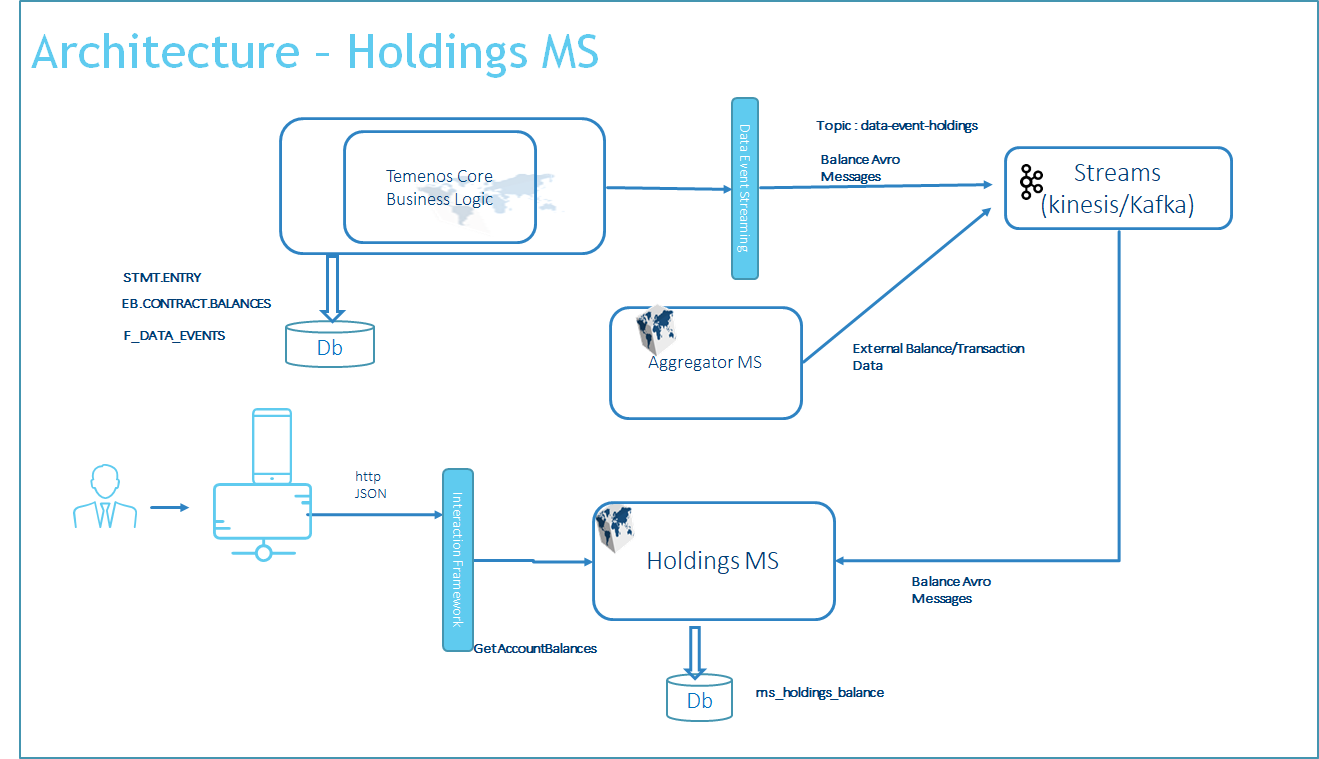
The objective of the Holdings Microservice is to store the accounting entries and customer account balances in a designated Microservices architecture. Any transaction initiated in Infinity sends a request to the core banking system and creates transactions. As soon as the transaction is created in the core banking system, it impacts the customer account entries and the account balances. A sophisticated integration framework integrates customer account entries and balances with the Holdings Microservice. As soon as the entries and balances are updated in the core banking system, a configured event passes the account entries and account balances to the Holdings Microservices in an asynchronous manner.
Following are some of the key functions in Holdings Microservice:
- Account list
- Account details
- Arrangement activities
- Balances of accounts arrangement
- Cash management – currency balances
- Dashboard
- Customer holdings
- Limit details
- Portfolio Values:
- daily Profit & Loss (PL) and their percentage,
- unrealized PL and their percentage
- Yearly Performance
- Market Values Security movements & Positions
- Customer Values:
- daily Profit & Loss (PL) and their percentage,
- unrealized PL and their percentage
- Yearly Performance
- Market Values
- Transactions Type details
- Third Party Banks accounts Balances (Account Aggregation)
- Portfolio valuation and Profit & Loss.
Following are the benefits of Holdings Microservice:
- Real-time integration between the Core Banking System and the Microservices using an Integration framework based on events.
- This Microservice provides real-time updates to entries and account balances in the client dashboard.
- Update client positions, holdings, limits, movements, and many more in real-time.
- The event-based mechanism passes the entries and balances of Holding Microservices in real-time.
- Integration capabilities with any core banking systems.
- Microservices can be integrated with one more core system.
Holdings and Arrangement MS Merger
Temenos Holding Microservice is used to store the accounting entries and Customer account balances in a designated microservices architecture. Any transaction initiated in Infinity will be sent as request to the Core banking system (Example: Transact) and which create transactions and hit the balances of accounts/ arrangements. While Temenos Arrangement Microservice is for used holding the basic information of arrangements and services, both Infinity and other systems like PI-TBC (Payment Initiation TBC), TPH (Temenos Payment Hub), TEP TBC (Temenos Enterprise Pricing TBC) and so on, that need customer arrangements information. Arrangement Microservice persists all the static information of the arrangements in the core banking system and provides the same details to the digital front office for providing LSM (Limited-Service Mode) features during the stand-in processing or a planned outage (For example, online upgrade of Temenos Transact).
The Arrangement Microservice holds the following details:
- Customer restrictions
- Customer roles that are associated with an arrangement.
- Account Arrangements
- Lending Arrangements
- Deposits Arrangements
- Interest and Bills
- Payment Schedules
- External Arrangements that are coming through AX module in Transact – like Credit card etc.,
- Facilities Arrangements
- Drawings Arrangements
- Portfolio Arrangements
- Accounts that are linked to Portfolios.
- Account Restrictions
- Third Party banks accounts and their details (Account Aggregation)
The Arrangement Microservice holds the following static data of customer.
- Capture the contract details created by Customer.
- Capture the payment schedule details for the contract.
- Support both Real Time and Near time processing style.
- Integrate with multiple systems for processing.
- To capture Portfolio related information for a Wealth customer.
Now Holdings Microservice is capable of handling the above-mentioned details with the newly added APIs.
Architecture
The following is the Architecture diagram of Holding Microservice.
In this topic